Red Hat AI for Intelligent Tax Administration
Red Hat · Four Inc. · Carahsoft
AI foundations for intelligent tax administration
Rung: data · information · knowledge · judgement
Red Hat · Four Inc. · Carahsoft — Virtual Event · September 17, 2026
What predictive AI, generative AI and LLMs actually do — then how Red Hat turns models, agency knowledge and automation into an operable mission capability, proven in eight labs you run yourself.
Presented by Jon Keam and Brad Scalio.
Four different jobs get called “AI”
Rung: information · knowledge · judgement
Treat AI as a toolbox, not a magic employee. Pick the tool by the job you need done.
| Term | What it actually does | Analogy |
|---|---|---|
Predictive AI — estimate (data → information) | Finds patterns in historical data to score, classify or forecast an outcome. | A weather forecast: “there is a 70% chance,” not a guarantee. |
Generative AI / LLM — create (information → knowledge) | Produces new language by predicting useful next tokens from patterns learned during training and context supplied now. | A very well-read drafting assistant — fast, fluent, and still capable of being wrong. |
Agentic AI — reason + act (knowledge → action) | Pairs a model with approved tools, state and rules so it can plan steps and call systems. | A junior analyst with a badge and a restricted tool belt — permissions still matter. |
Automation — execute (executes judgement) | Runs deterministic, tested steps when a condition or human decision says to act. | A checklist that actually performs the checklist. This is where Ansible belongs. |
Predictive AI is not a crystal ball. An LLM is not a database, policy authority or source of truth. An agent is not permission to bypass controls.
The work is seasonal, textual and unforgiving
Rung: data
Demand | Peak load, fixed staff | Idle capacity in August is unjustifiable; exhausted capacity in April is a headline. A year of demand arrives in six weeks — April is 6× the August low. |
Systems | Rules locked in legacy code | Rewriting the systems of record is a decade. Wrapping them in intelligent workflows is a quarter. |
Data | The answers are in the text | Correspondence, transcripts and case notes are unstructured — exactly what language models are built for. |
The constraint that decides everything | The data cannot leave (data — it stays) | FTI handling rules rule out public endpoints. The model comes to the data — on premises, accredited cloud, or air-gapped enclave. |
An LLM is the engine — not the whole vehicle
Rung: data · information · knowledge · judgement
| Layer | What it is |
|---|---|
Mission app (judgement) | The taxpayer-service UI, case workflow or console that asks for help. |
Context / RAG (knowledge) | The approved guidance for this exact question — the open book. |
Model / LLM (information) | Learned language patterns — not your live system of record. |
Inference (data → information) | The engine — vLLM, the Red Hat AI Inference Server. |
Platform (executes judgement) | Identity, scaling, isolation, lifecycle, policy — RHEL and OpenShift AI. |
Compute + data (data) | Accelerators and agency data — wherever authorization requires. |
Fine-tuning is studying for the test. Retrieval is bringing the notebook. You want both — and neither makes the model a source of truth.
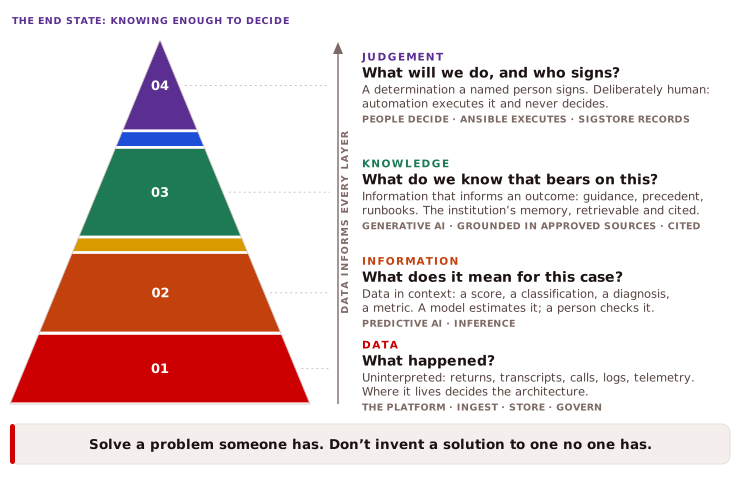
From data to judgement — and who climbs each step
Rung: data · information · knowledge · judgement
Every step up is worth more to the mission. AI moves the work up the ladder — it never takes the top step.
| Rung | What it is | Looks like | Who climbs to it |
|---|---|---|---|
Data (data) | What happened, uninterpreted | returns · transcripts · calls · scans | — |
Information (information) | Data in context for one case | matched · flagged · routed by intent | Predictive AI — score · match · flag |
Knowledge (knowledge) | Information that informs an outcome | guidance · precedent · taxonomies | Generative AI + RAG — read · ground · draft |
Judgement (judgement) | A determination someone signs | the decision — and the accountability | People — decide and sign. Stays human. |
The backlog lives at the bottom of the ladder. Transcribing, matching, routing and summarizing consume the workforce. Every hour a machine absorbs down there is an hour an examiner spends deciding — the only work that resolves a case.
Judgement is deliberately never automated. The model classifies, grounds and drafts; a named person decides and signs. That is a design rule, not a technical limit — and it is what makes the deployment defensible to counsel and oversight.
Predictive and generative AI answer different questions
Rung: information · knowledge
They fail differently — so they are governed differently.
| Predictive AI (data → information) | Generative AI (information → knowledge) | |
|---|---|---|
learns from | Patterns in structured history — filings, payments, outcomes | Language itself — how guidance, notices and case notes are written |
produces | A number: a score, a forecast, a flag | Text: a classification, a draft, a summary, a cited answer |
in tax terms | Refund-risk scoring · workload forecasting · anomaly flags | Read correspondence · draft notices · summarize case files · answer from guidance |
fails as | A bad number — visible in precision and recall | A plausible sentence — which is why grounding and review are non-negotiable |
governed by | Back-testing, thresholds, fairness metrics | Retrieval with citations, human sign-off, drift monitoring — Labs 04 · 06 |
In the interactive deck this slide is a single graphic: predictive and generative overlap where a score picks the case and a draft explains it, and a person decides.
Where AI actually lands in the filing lifecycle
Rung: judgement
AI lands on the first four stages, where a reviewer already checks the output; the decision stays with a person; operations close the loop.
| # | Station | What happens | Who acts |
|---|---|---|---|
01 | Intake | Capture correspondence from any channel | AI reads it |
02 | Classification | Understand intent, route to the case type | AI classifies |
03 | Guidance | Rules, policy and precedent | AI grounds and cites |
04 | Drafting | Letters, responses, memos, with citations | AI drafts |
05 | Review | Check accuracy, add judgment, approve | Human in the loop |
06 | Decision | Finalize and issue the outcome | A person signs |
07 | Notice | Send letters and update records | Automation executes |
08 | Operations | Track performance, learn and improve | The loop closes |
Start where a human already reviews the output (judgement stays human). If a person signs the letter today, a model that drafts it changes throughput without changing accountability. That is a defensible first deployment.
Automate the toil around the model, not just the model (executes judgement). Most of the effort in production AI is provisioning, patching, scaling and evidence collection. That is an automation problem, and it is solved.
Five outcomes, and where each one is proven
Rung: data · information · knowledge · judgement
| Outcome | Delivered by | Lab |
|---|---|---|
Modernize mission-critical operations (executes judgement) — wrap legacy systems in intelligent workflows instead of rewriting them. An error string in a log fires an Event-Driven Ansible rule, a playbook runs on the right hosts, the on-call gets an email, and a ticket opens and closes in ServiceNow or Remedy. The system of record stays untouched. | Ansible Automation Platform · Event-Driven Ansible · OpenShift | 05 · 07 |
Improve efficiency and accuracy (information, knowledge) — classification, extraction and drafting move first-pass work off people. | Red Hat AI Inference Server · SDG Hub + Training Hub | 01–02 |
Unlock data-driven insights (knowledge) — retrieval grounds every answer in your own published guidance, with the citation returned alongside. | Red Hat OpenShift AI · vector store · Llama Stack | 04 |
Strengthen security and compliance (evidence → judgement) — signed models, FIPS-validated cryptography, continuous compliance scanning and bias/drift monitoring as platform features. | RHEL · Compliance Operator · TrustyAI · Sigstore | 06 |
Build an AI-ready foundation (data → information) — one platform, one operating model, from a datacenter GPU node to an accredited cloud region. | OpenShift AI · KServe · Red Hat AI Inference (vLLM) | 03 |
One foundation, from bare metal to the taxpayer
Rung: data · information · knowledge · judgement
Most failures happen at the seams between systems, not inside them. The platform’s job is to make those seams boring.
| Layer | What it provides | Lab |
|---|---|---|
Mission applications (judgement) | Correspondence intake · notice drafting · case summarization · guidance assistant. Systems of record stay where they are — reached through APIs and automation, not replaced. | — |
Red Hat OpenShift AI | Model serving — KServe + vLLM (information) · Training — SDG Hub · Training Hub (knowledge) · Pipelines — tune · eval · ship (knowledge) · Model registry — signed versions (judgement) · Retrieval — vector store (knowledge) | 02 · 03 · 04 · 07 |
Red Hat OpenShift (data) | Scheduling · GPU partitioning · network policy · multi-site placement · GitOps delivery. The same cluster runs the modernized case-management apps beside the models they call. | — |
Red Hat Enterprise Linux · AI Inference Server (data) | Bare metal GPU nodes · virtualized datacenter · accredited public cloud · classified enclave. Granite models, accelerator drivers and the vLLM-based AI Inference Server in one supported stack. Tested with the hardware: mainframes · TPM · PIV/CAC cryptography. | 01 |
Two vertical bands run through every layer: Trust (judgement) — signed models, FIPS crypto, SELinux, Compliance Operator, TrustyAI drift + bias, audit trail, air-gap mirroring (Lab 06); and Automation (executes judgement) — Ansible Automation Platform and Event-Driven Ansible: provision, patch, remediate, evidence collection (Lab 05).
The federal problem is not “get a model.” It is operate AI without giving up control.
Rung: data · information · knowledge · judgement
Bring the model to the mission — not the mission data to somebody else’s model. Use the model, accelerator and deployment location that fit the workload. One operating model across datacenter, accredited cloud, edge and disconnected — and a glass box you can open and inspect, not a black box.
Inference — serve efficiently with vLLM / llm-d · Data — connect private agency knowledge · Agents — govern tool-using workflows · Platform — scale and operate consistently.
| Take-home reference | Why it matters | |
|---|---|---|
Choice | Model freedom (knowledge) | Open models and standard APIs keep the exit open. Modern lock-in limits what you can build next — a worse trap than the old hardware kind. |
Control | Data locality (data) | Run inference inside the boundary dictated by FTI, mission data, sovereignty and accreditation. |
Operations | Models-as-a-Service (information) | Central platform teams publish governed model endpoints other projects consume — instead of every project building its own fragile AI stack. |
Economics | Use accelerators efficiently (data) | vLLM and distributed inference focus on throughput, latency and cost per token rather than GPU ownership as a trophy. |
Lifecycle | Predictive + generative (information, knowledge) | OpenShift AI manages the lifecycle of traditional ML and generative workloads so they can coexist in one operational model. |
Execution | Ansible closes the loop (executes judgement) | Provision, configure, remediate and collect evidence with deterministic automation around probabilistic AI. |
Define the service once — run it wherever the mission needs it
Rung: data · information · judgement
One service definition (executes judgement) — inferenceservice.yaml, a signed
model (granite-8b-tax-v1), GitOps delivery from the main branch. Infrastructure
as code — the manifest is the capacity plan (Lab 03). oc apply — unchanged:
same image · same controls · same skills.
| Runs unchanged in | What differs | |
|---|---|---|
Datacenter — bare-metal GPU nodes (data) | Your floor, your hardware, shortest path to the systems of record | the iron |
Accredited cloud region (data) | FedRAMP boundary; surge capacity rented for the season, released after | the boundary |
Air-gapped enclave (data) | Mirrored registry and models; no internet at inference or update time | no internet |
Accredit once, inherit everywhere (accredit once — judgement). Signing, FIPS mode, compliance scanning and drift monitoring attach to the platform — so workflow two starts with workflow one’s evidence, and the skills and pipelines carry over the same way.
April becomes a scheduling event (information at scale). The 6× filing surge is absorbed by autoscaling on pooled GPUs (Lab 03) — capacity follows the season instead of sitting siloed inside one project’s budget.
Placement is policy, not re-architecture (data — where it lives). Moving a workload is a redeploy of the same manifest. Residency and cost decide where it runs, and the exit door stays open.
The useful pattern is a loop, not a chatbot
Rung: information · knowledge · judgement
Predict, explain, act: spot the pattern, turn the signals into language, use only what the agency has approved. Grounding and learning are how the loop earns the right to act; the connected estate underneath is the discriminator nobody else has.
| Step | Technology | What happens |
|---|---|---|
01 · Predict — spot the pattern | Predictive ML (information) | Telemetry and historical incidents estimate risk: saturation, failure probability, anomaly or likely incident class. |
02 · Explain — turn signals into language | GenAI / LLM (information) | The LLM summarizes logs, changes and symptoms into a human-readable hypothesis and next questions. |
03 · Ground + act — use what the agency approved | RAG (knowledge) · Ansible (executes judgement) | RAG retrieves runbooks and prior fixes; policy decides whether Ansible recommends, requests approval or remediates. Every action opens and closes an ITSM ticket (ServiceNow, Remedy), so the incident record is the trail. Lab 05. |
The knowledge flywheel | (knowledge) | After review, the incident summary, root cause, evidence and successful remediation become searchable operations knowledge for the next event. Generated content is a draft until it passes the same curation and authority rules as any other knowledge record. |
Example — “Why is this service slow?” Predictive AI says GPU queue depth is abnormal. The LLM explains the evidence. RAG cites the approved saturation runbook. Event-Driven Ansible scales or reroutes after the required approval.
Boundary — do not let fluency become authority. The LLM can propose a root cause. Telemetry, system state, retrieved source material and deterministic checks establish whether that explanation is actually supported.
Point the same pattern at your logs — MTTR is the proof
Rung: data · information · knowledge
The Lab 04 retrieval stack, aimed at operations: logs, runbooks, incident history and change records become a private notebook the on-call engineer can question — on the cluster, inside the boundary.
| detect | diagnose | fix | total | |
|---|---|---|---|---|
Before — grep · page · guess | unchanged | 2h 41m | 22m | 3h 16m |
With the notebook — ask · verify · act | unchanged | 24m | 22m | 59m |
Diagnosis −84%: the notebook answers “what changed, has this happened before, which runbook applies” in seconds, with citations. Detect, fix and verify are unchanged — the hours lived in diagnosis. Lab 07 walks it end to end.
Dashboards answer anticipated questions (information). A notebook over your own data answers the one you did not anticipate — in language, with citations you check before acting.
Logs are FTI-adjacent (data). They carry hostnames, account fragments and case identifiers. The notebook runs on the same OpenShift install it observes — nothing is exported to anyone’s hosted service.
Same stack as the taxpayer system (knowledge). The team that grounds answers for operations (Lab 07) has already built the taxpayer-facing version (Lab 04) — one retrieval pattern, two corpora, one governance story.
Ninety days, then ninety more
Rung: data · information · knowledge
Crawl, walk, run. Nothing here requires a rewrite of a system of record — ground the current phase before you scale, and each phase produces something you can show.
| Prove (data) — crawl · days 0–90 | Ground (information) — walk · days 90–180 | Scale (knowledge) — run · days 180+ |
|---|---|---|
Stand up one supported endpoint with the AI Inference Server | Move serving onto OpenShift AI with autoscaling | Promote through a model registry with real approvals |
Agree the accelerator capacity plan and where it physically sits | Add retrieval over your own published guidance | Add workflows two through five on the same platform |
Settle which data classes may be used, in writing | Tune on agency vocabulary with SDG Hub + Training Hub | Prove the filing-season surge with a load rehearsal |
Pick one text-heavy workflow with a human already reviewing | Wire drift, fairness and compliance monitoring | Extend to the disconnected or classified enclave |
Measure the baseline before you change anything | Automate provisioning and patching end to end | Report outcomes in mission terms, not token counts |
one workflow live, measured | grounded · monitored · automated | surge-proven at scale |
What happens after this hour
Rung: judgement
Step zero · Lab walk-through. An hour where we run the eight labs together, show and tell, and find the point in the stack where you want to prove value. That scopes the pilot.
Step one · Architecture workshop. A half-day with your platform and security teams to size accelerators, place the first workload and name the data classes in scope.
Step two · Guided pilot. One workflow, on your infrastructure, with a measured baseline and an agreed definition of success before we start.
Step three · Acquisition path. Four Inc. and Carahsoft carry the vehicles and pricing — bring them in early, not at the end.
Point of contact — Brad will follow up. Brad Scalio, Red Hat, bscalio@redhat.com: if nothing else, he will get you to the right person. IRS account executive: Ted Craig, Red Hat. Everyone else, email Brad and he connects you to yours.
Take the labs with you. Everything from today — deck, labs, guides — at https://nommsweymx.github.io/redhat-ai-tax-labs/ (source: github.com/nommsweyMX/redhat-ai-tax-labs). The eight labs are the commands your engineers will run on day one. Follow it on your own: https://nommsweymx.github.io/redhat-ai-tax-labs/adventure.html.
Your move (the next decision is yours).
Already a Red Hat customer? Ask for your Solution Architect. Not sure who that is? Email Brad, open a ticket in the Customer Portal and ask support, or ask through your management line. The foundational questions are free to ask and expensive to skip.
Start a community of practice. A standing group across platform, security and mission teams, built around one workflow. We will help seed it and we will show up.
Bring your hardest question. Air-gapped operation, FedRAMP boundaries, accelerator scarcity, model provenance. If you did not see it here today, that does not mean it does not exist — ask.
Bring your cyber team. If nobody from IRS cyber is on today, refer us to your ISSO or security lead. We will run a dedicated security session for them: the appendix, in depth.
Eight labs — real commands, run them yourself
Rung: data · information · knowledge · judgement
An opinionated path on a personal laptop — not an MVP, never production, never on a government computer. Free of charge and open to anyone: one self-contained HTML on the Carahsoft event page, source at https://nommsweymx.github.io/redhat-ai-tax-labs/. Prove it to yourself: watch the model serve on 127.0.0.1.
| Lab | Title | What you do |
|---|---|---|
01 · Inference Server | Serve a model inside your boundary (data → information) | Pull the vLLM-based inference server, serve a validated Granite model, and classify a taxpayer inquiry — without a single byte leaving the host. |
02 · Customization | Teach it your notice taxonomy (knowledge) | Add agency knowledge as seed YAML, generate synthetic data with SDG Hub, tune with Training Hub, and evaluate against the base model. |
03 · OpenShift AI | Survive filing season (information at scale) | Deploy with KServe and vLLM, then watch it autoscale from two replicas to twenty under an April load rehearsal. |
04 · Retrieval | Ground answers in your own guidance (knowledge) | Ingest a publication corpus into a vector store and return answers that carry their citation. |
05 · Ansible | Automate the toil around the model (executes judgement) | An Event-Driven Ansible rulebook detects inference saturation and remediates it before anyone opens a ticket. |
06 · Trust | Prove it to your ISSO (evidence → judgement) | Verify the model signature, check FIPS, run a compliance scan and read drift metrics off live traffic. |
07 · Ops notebook | Ask your own logs (information → knowledge) | Ingest logs, runbooks and incident history into an on-cluster notebook, diagnose a live incident with citations — then read the MTTR numbers. |
08 · The whole loop | One loop, end to end (data → judgement) | Mainframe and server logs in, an outage-risk model scores who fails next, Lightspeed drafts the rulebook and playbook, a person merges, Event-Driven Ansible runs it, and the assistant answers "how is server8-audits?" with job evidence. |
One thing to remember: nothing here needed a public endpoint. No public model endpoint, no internet connection at inference time, no rewrite of a system of record. The labs run the upstream bits on a laptop; what an agency accredits is the supported Red Hat product built from them. Lab 08 chains the whole loop.
One loop, end to end: from mainframe logs to an assistant that probes
Rung: data · information · knowledge · judgement
Lab 08 · the whole loop. Logs in, risk scored, fix drafted by Lightspeed, merged by a person, run by Event-Driven Ansible, remembered by the platform, so you can ask.
Mainframe + servers (data): MVSA · server1..12
Vector · Loki (data): OpenShift Logging
outage-risk scorer (information): KServe · sklearn · OpenShift AI
Granite · Lightspeed (knowledge): vLLM · OpenShift AI
Pull request (judgement): a person reviews and merges
Repo → AAP → EDA (judgement): the merge is the promotion
Event-Driven Ansible (judgement): approved job templates
Knowledge base + assistant (knowledge): pgvector · ops notebook; ask, then probe, and the loop starts again
| Question | Answer, with its evidence |
|---|---|
How is server1-taxreturns? | Online, up 41d, mem 62%, 72h risk 0.22 and falling; last change CR-9088. [job 40518 · journald · RB-214] |
How is server8-audits? | Restored 03:13 by job 40512 (Xmx 7g); risk 0.91 → 0.34; PR #482 merged, INC-2340 closed. [job 40519] |
Which servers are showing online? | 13 of 14: server1..12 ok, MVSA reachable, MVSB in its IPL window until 06:00. [job 40520 · estate ping] |
The loop is the documentation. Every promoted change, its review thread and its job outcome are indexed where the assistant searches. The KM system writes itself.
Two kinds of AI, one platform. The scorer and the drafter share a GPU node, a registry and an identity. Predictive and generative are pods, not projects.
Promotion is a merge. Repo, AAP and knowledge base update together, and a person decides. Nothing runs from a chat window.
Ask, then probe. The assistant’s tools are approved job templates, so "how is server8?" becomes a job with evidence, not a guess.
The questions an authorizing official will ask
Rung: information · judgement
Evidence is information (information) — the authorizing official’s decision is judgement (judgement). The platform produces the first so a person can make the second.
| Their question | The platform control | Where it lives | Proven in |
|---|---|---|---|
Where does our data go when someone prompts the model? | Nowhere. Inference runs on your cluster, in your enclave, on your accelerators. | AI Inference Server · OpenShift AI | Lab 01 · 127.0.0.1, no egress |
Can you prove this model is the one we approved? | Model artifacts are signed and verified before they are admitted to the cluster. | Sigstore / cosign | Lab 06 · cosign verify |
Is the cryptography validated? | FIPS mode is set once in RHEL CoreOS and inherited up the chain by OpenShift and OpenShift AI; where a component is not inherited, the exception is documented and covered by compensating controls. | RHEL FIPS mode | Lab 06 · fips-mode-setup, sestatus |
Does it work with our smart cards and hardware crypto? | Tested with the hardware vendors: TPM, PIV/CAC smart-card authentication and hardware cryptography supported from the operating system up, on mainframes included. | RHEL · hardware certification | Slide 09 · base band |
Can this land in our FISMA moderate or high boundary? | Platform controls map to the NIST 800-53 moderate and high baselines; your FIPS 199 categorization picks the venue — the platform is the same in all of them. | RHEL · OpenShift | Slide 11 · one manifest |
How do we know it stays compliant next quarter? | Scheduled scans against a hardening profile, with machine-readable results. | Compliance Operator | Lab 06 · compliancescan |
What about the applications and containers we build on it? | The same tooling spans your own application lifecycle on the platform: signing, scanning and admission policy at build, at deploy and at run time. | OpenShift build · registry · admission | Lab 06 · signature gate |
How do we detect the model drifting or skewing? | Continuous drift and fairness metrics on live inference traffic. | TrustyAI | Lab 06 · drift, fairness |
What if we have no internet at all? | Mirror images and models into the enclave; the platform is built for disconnected operation. | oc-mirror · registry | Slide 11 · enclave |
Who is accountable when it is wrong? | A named reviewer on the signature, and every automated action launched from one governed console under enterprise RBAC, so each action carries the identity that ran it. | Workflow design · Ansible Automation Platform | Lab 05 · job history |